Home · Free printables
Free calm down corner poster
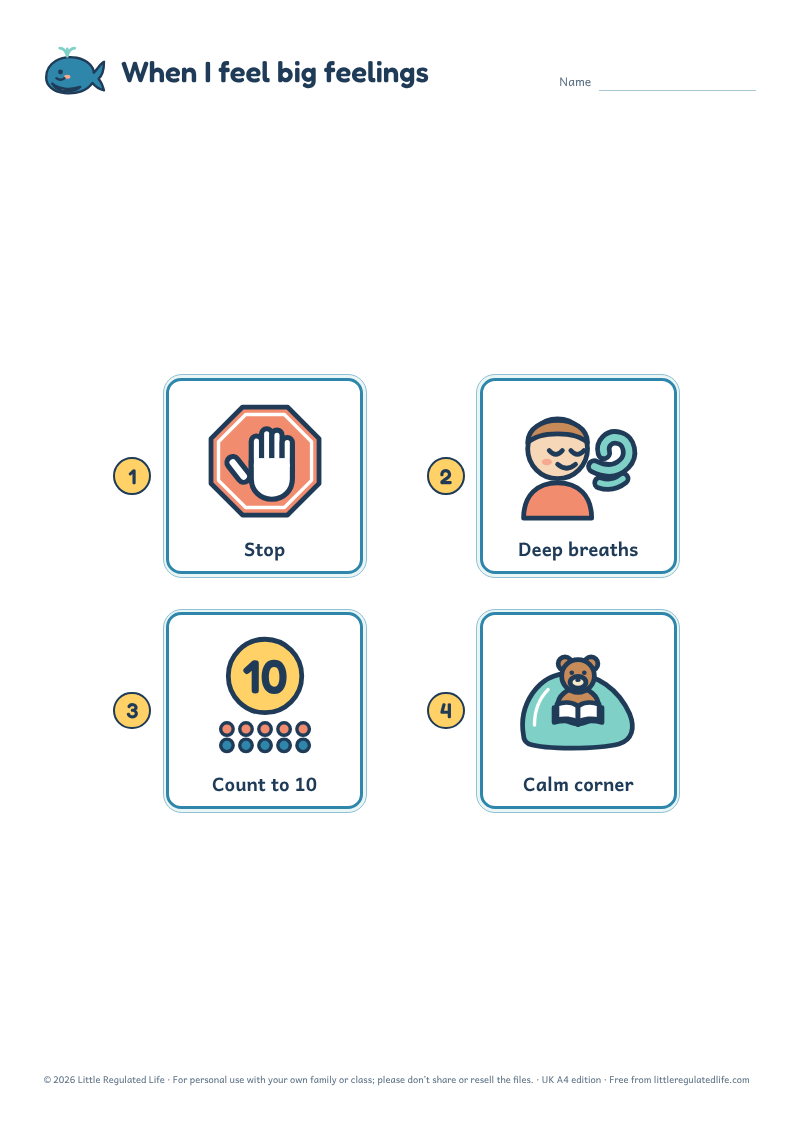
The calm-down steps in pictures: stop, take deep breaths, count to 10, then a calm choice. Free, in UK A4 and US Letter, for the wall of your calm corner.
Get the free pack
Tell us where to send it and the download page opens straight away. You get the First and Then starter set, the feelings chart and the calm-down poster, all in UK A4 and US Letter, plus 20% off your first kit.
One email with the link, then an occasional note when a new kit comes out. Unsubscribe any time. Privacy notice.
What’s on the poster
- The four calm-down steps in pictures: stop, take deep breaths, count to 10, choose something calm
- Big, clear pictures a child can follow from across the room
- One page, the same style as the full Calm Down Corner kit
How to use a calm down corner
A calm corner is a small, predictable place with the plan on the wall. When a big feeling arrives, words are the first thing to go, so the poster does the talking: stop, breathe, count, choose. Practise the steps on calm days first, so they’re familiar when they’re needed. Keep the corner for calming down, never as a punishment.
Add three to six things that really help your child: a weighted blanket, a squeeze ball, headphones, a book, a hug. The full kit has a calm choices board and 18 picture cards for exactly that.
Who it’s for
Autistic children, children with ADHD, and any child who needs a plan for big feelings. Parents use it at home; teachers use it in a calm area of the classroom. Made by a dad for his own autistic, ADHD son.
Printing
Print on card, laminate if you can, and stick it at your child’s eye level in the calm corner. It prints fine in black and white.
Guide
How to set up a calm down corner
More free printables
Kits that go with it
- Calm Down Corner Kit (£4.49): A Calm Corner sign, 8 calming posters, a feelings scale, a calm choices board and 18 cards.
- Calm and Feelings bundle (£7.99): The Calm Down Corner Kit, Feelings kit, break cards and token board in one download. Save £5.97.
Made by a dad to an autistic son with ADHD. An everyday visual planning tool, not medical or therapy advice. If you’re worried about your child, talk to your GP, health visitor or school SENCo.